
Your cold emails get fewer replies every quarter, and your LinkedIn invites sit unanswered for longer. You're not imagining it. A new survey of 300 B2B software and AI companies rates cold outreach as over-saturated. Meanwhile, signal-based outbound is already here: half of teams are experimenting with it, and 48% plan to put more money into it next year. The report calls it "the next big thing." For the teams already running it, it's simply how outbound works now.
This post covers what the data says, why it matters for your pipeline, what you need to change, and how we used signals to grow Seleqt itself.
- Cold outreach is over-saturated. The 2026 State of B2B GTM Report puts it in the "popular, but lower impact" group, next to digital ads.
- Signal-based outbound is already here. Half of teams are experimenting with it, and 48% plan to invest more in 2027, second only to AI search (50%).
- Outbound is gaining ground. Leaving out founder-led sales, outbound grew from 19% to 24% as teams' primary GTM motion, while account-based and PLG both fell.
- Buyers punish irrelevant outreach. Gartner found 73% of B2B buyers actively avoid suppliers who send it.
- Our own test: tracking the Trigify shutdown on LinkedIn surfaced 96 posts and about 6,400 engagers, and gave us 15 qualified leads in the first week.
- Signals alone don't book meetings. You still need qualification, contact details and a message that references the signal, sent while it's fresh.
What is signal-based outbound?
Signal-based outbound is outreach triggered by a sign that a company or person may be ready to buy now, such as engaging with a competitor's post, hiring for a role your product supports, or appointing a new sales leader. Instead of working through a static list, you contact the people whose situation just changed, and you tell them why you're reaching out now.
Signals come in two kinds:
- First-party signals happen on your own channels: someone engages with your content, visits your website or uses your product.
- Third-party signals happen elsewhere: social activity, job changes, hiring, leadership changes, company news or a change in tech stack.
How is this different from intent data? Intent data usually means third-party research activity, such as a company reading many articles on a topic, rolled up to the account level. It's one type of signal. Signal-based outbound is the practice of acting on any of them: spotting the signal, checking the fit and reaching out while it still matters.
What does the 2026 State of B2B GTM report say about outbound?
Kyle Poyar of Growth Unhinged and Maja Voje of GTM Strategist surveyed 300 B2B software and AI companies in September 2026 and published the 2026 State of B2B GTM Report on October 14. Three findings matter for anyone running outbound.
Outbound is gaining ground
Founder-led sales is the most common primary GTM motion overall (26%), followed by inbound (19%) and outbound (18%). Founder-led was new to the survey this year, so the authors left it out to compare with 2025. On that basis, outbound grew from 19% to 24%, while account-based fell from 18% to 13% and PLG from 18% to 12%.
Outbound also leads for bigger deals. Companies selling above $50k pick it as their primary motion more than any other (31%).
Cold outreach is over-saturated. Signals are taking its place
The report plots 16 channels by how popular they are and how likely they are to have a big impact:
| Group | What it means | Channels |
|---|---|---|
| Tried-and-true | Popular and high impact | Network and intros, intimate events, AI search, SEO, LinkedIn posting |
| The next big thing | High impact, not yet mainstream | Signal-based outbound, ecosystem partnerships |
| Over-saturated | Popular, lower impact | Cold outreach, digital ads |
| Figuring it out | Less common, lower impact so far | Product launch campaigns, newsletters, cold calling, B2B creators, PR, agentic campaigns (AI SDR) |
Kyle Poyar's summary is blunt: "Cold outreach is officially oversaturated."
That doesn't mean cold outreach is dead. It's still tied for the second most-used channel for $5–50k deals (33%). It means a lot of teams send it, and each message earns less than it used to. AI SDRs, sending on autopilot, sit in the "figuring it out" group for now.
Half of teams are already experimenting with signals
Signal-based outbound was the most common experiment in the survey: 50% of teams are trying it. And it's near the top of next year's plans:
| Channel | Teams planning to invest more in 2027 |
|---|---|
| AI search (AEO) | 50% |
| Signal-based outbound | 48% |
| Intimate events | 42% |
| LinkedIn posting | 34% |
| Ecosystem partnerships | 28% |
| Cold calling | 11% |
From $1M ARR up, every revenue group named the same top three bets: AI search, signals and intimate events.
A note on the data: the survey is self-reported, investment plans are intentions rather than results, and the report had sponsors, including outbound and signal vendors. We think the direction is clear. Read the numbers as where teams are heading, not as a guarantee.
Why should you care?
If outbound is part of how you grow, this shift affects your pipeline whether you change or not.
Your cold outreach now competes in a crowded channel
Over-saturated means many teams do it and fewer get results from it. Buyers notice. In a Gartner survey of 632 B2B buyers, 73% said they actively avoid suppliers who send irrelevant outreach. Every untargeted message risks turning a future buyer away, and high-volume sending puts your domains and LinkedIn accounts at risk too.
Half your market is already doing it
The report's "next big thing" label means high impact, not yet mainstream. But half of teams are already experimenting with signal-based outbound, and nearly as many plan to invest more next year. If you're not testing signals yet, you're behind half your market. The good news: it isn't crowded yet, so the teams that get good at it now still get buyers' attention first.
Timing decides who gets the meeting
Gartner's B2B buying research found that buyers spend only about 17% of their buying journey meeting potential suppliers, and that time is shared across every supplier they consider. In the same 2025 survey, 61% of buyers said they prefer a rep-free buying experience overall. Reaching someone right when something changes, like a new leader, a hiring push or interest in a competitor, is how you get into that small window before the shortlist is set.
More volume isn't the answer
Gartner's 2026 CMO Spend Survey puts marketing budgets at 7.8% of company revenue, barely up from 7.7% in 2025. Our reading, not Gartner's: with flat budgets, you can't buy better results with more sending. The gains have to come from getting more out of every message.
Agencies: your clients read this report too
Clients will start asking for signal-based campaigns. Agencies that already run them can sell them as a premium service instead of competing on list-and-send volume.
Which signals do teams actually act on?
The report also asked which signals teams act on. First-party signals lead. Third-party signals are much less mature, which is exactly where the opportunity is.
| Signal | Teams acting on it | What it suggests | How to open |
|---|---|---|---|
| Content engagement (first-party) | 52% | Interest in the topic you write about | Continue the topic with something useful |
| Website visits (first-party) | 42% | Active research, often on product or pricing pages | Offer help with the question they're likely researching |
| Product usage (first-party) | 40% | Hands-on evaluation or room to expand | Offer setup help or the next step |
| Social activity | 30% | Interest in a topic, a competitor or a peer's post | Reference the topic, not the like |
| Champion movements | 28% | A past buyer or user joined a new company | Congratulate them and reconnect |
| Hiring activity | 25% | Budget and a problem your product may solve | Tie your offer to the role they're hiring for |
| Leadership changes | 24% | A new leader may review tools and processes | Offer a quick win for their first months |
| Company events | 17% | Funding, expansion or a launch shifts priorities | Connect your offer to the new goal |
| Tech changes | 14% | They're adding, replacing or dropping a tool | Help with the switch |
Tech changes come last, at 14%. As our own example below shows, that's a missed opportunity: when a company has to replace a tool, the timing is already on your side.
For more examples and openers, see our list of 15 buying signals.
What do you need to change?
Moving to signals isn't a new tool on top of your old process. It changes how you target, write, spend and measure.
| Area | Cold outreach | Signal-based outbound |
|---|---|---|
| Targeting | Big static lists from filters | Your ICP, narrowed down by a recent event |
| Timing | Whenever the campaign launches | Within days of the signal |
| Message | A generic value proposition | Opens with why you're reaching out now |
| Volume | High volume, low reply rate | Smaller weekly batches, more relevant replies |
| Budget | More mailboxes and data credits | Signal sources, qualification and contact data |
| Tools | A list tool plus a sequencer | Signal, qualification, contact data and sending, connected |
| Success metric | Sends, opens and replies | Meetings booked per signal type |
Your practice
Start every campaign from an event, not a filter. Keep your ICP list as the pool, and let signals decide who gets contacted and when. Review new signals daily or weekly, because they fade. The most common failure is spotting a signal and acting on it too late.
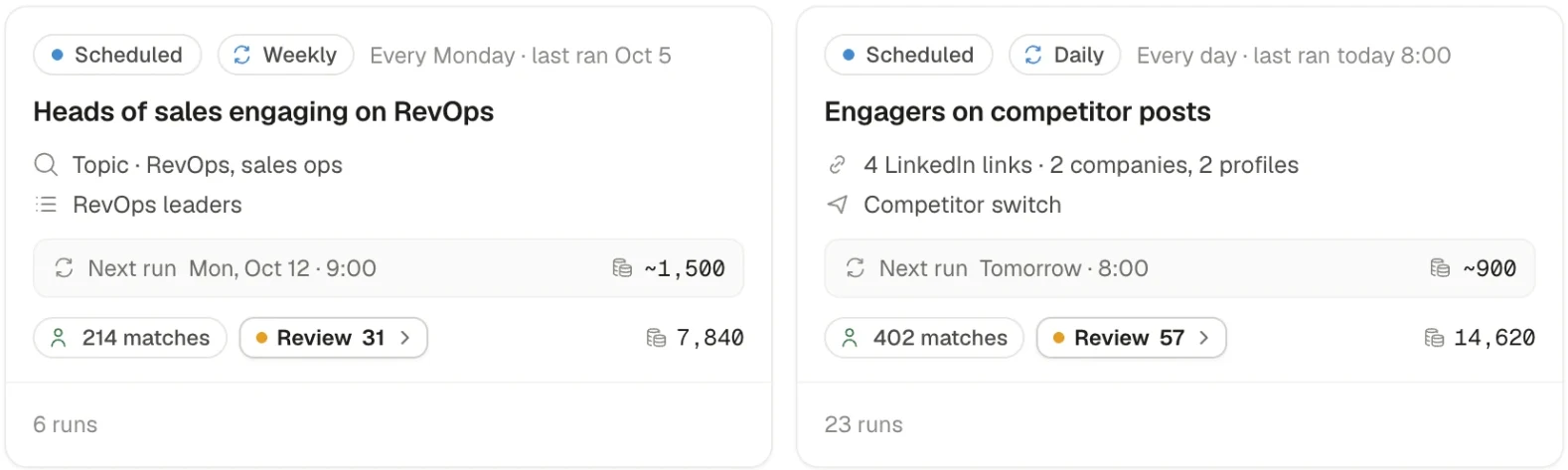
Your messaging
The first line explains why you're writing now: "Saw you're hiring three SDRs." Keep messages short and skip generic openers. This is the direct answer to Gartner's 73%: buyers avoid irrelevant outreach, so make the relevance obvious in the first sentence.
Your budget
Move spend from volume to precision. Fund your first test from what the report calls over-saturated, such as part of your cold-list volume or digital ad spend. Run it for 30 days, compare meetings booked against what the old approach produced, and then decide how much to move. That split is our recommendation; the report doesn't prescribe one.
Your toolset
A typical signal stack has four to six tools: a signal tool, Clay or a spreadsheet, a data provider, an email sequencer, a LinkedIn tool and a CRM. Signals lose time at every handoff between them. Whatever you choose, your stack needs:
- The signal sources that matter for your buyers
- Qualification against your ICP that shows its reasons
- Contact details from more than one provider
- Multichannel sending that can reference the signal
- One inbox for every reply
- CRM sync and meeting tracking
See how one workspace compares with a typical agency tool stack.
Your team
Someone has to own signals: which ones to watch, how to qualify them and which messages work. The report shows how fast this role is growing. Above $10M ARR, the GTM engineer (14%) is now tied with the account executive as the second most common GTM hire. SDRs shift from sending volume to reviewing leads and writing better messages.
Your metrics
Track meetings booked per signal type, not just reply rate. Keep the signals that turn into meetings and drop the ones that don't.
- Treating every like as buying intent. Engagement shows interest, not budget. Qualify before you reach out.
- Being creepy. Write "Saw your team is growing," not "I saw you liked Mark's post." Reference the topic or the change, not the click.
- Acting too late. A signal from three weeks ago is just another cold lead.
- Expecting the old volume. Lists get smaller. Replies should get better.
- Moving CSVs between tools. Every export and import is a day the signal gets older.
You can build all this from four to six tools, or run it in one. Here's how we run it at Seleqt, starting with a campaign we ran on ourselves.
How does Seleqt run signal-based outbound?
The best test of a signal tool is whether it can grow the company that builds it. So here's a real campaign we ran with Seleqt, for Seleqt.
Our own example: helping Trigify users move
On September 23, 2026, Trigify announced it was retiring its standalone platform, with access ending on October 22. Every team that relied on it had about a month to replace its signal workflow.
In the report's terms, that's three signals at once: a company event (the shutdown), a tech change (every user had to switch tools) and social activity (people reacting to the news on LinkedIn). Tech changes are the signal teams act on least, at 14%. Here's what happens when you do act on one.
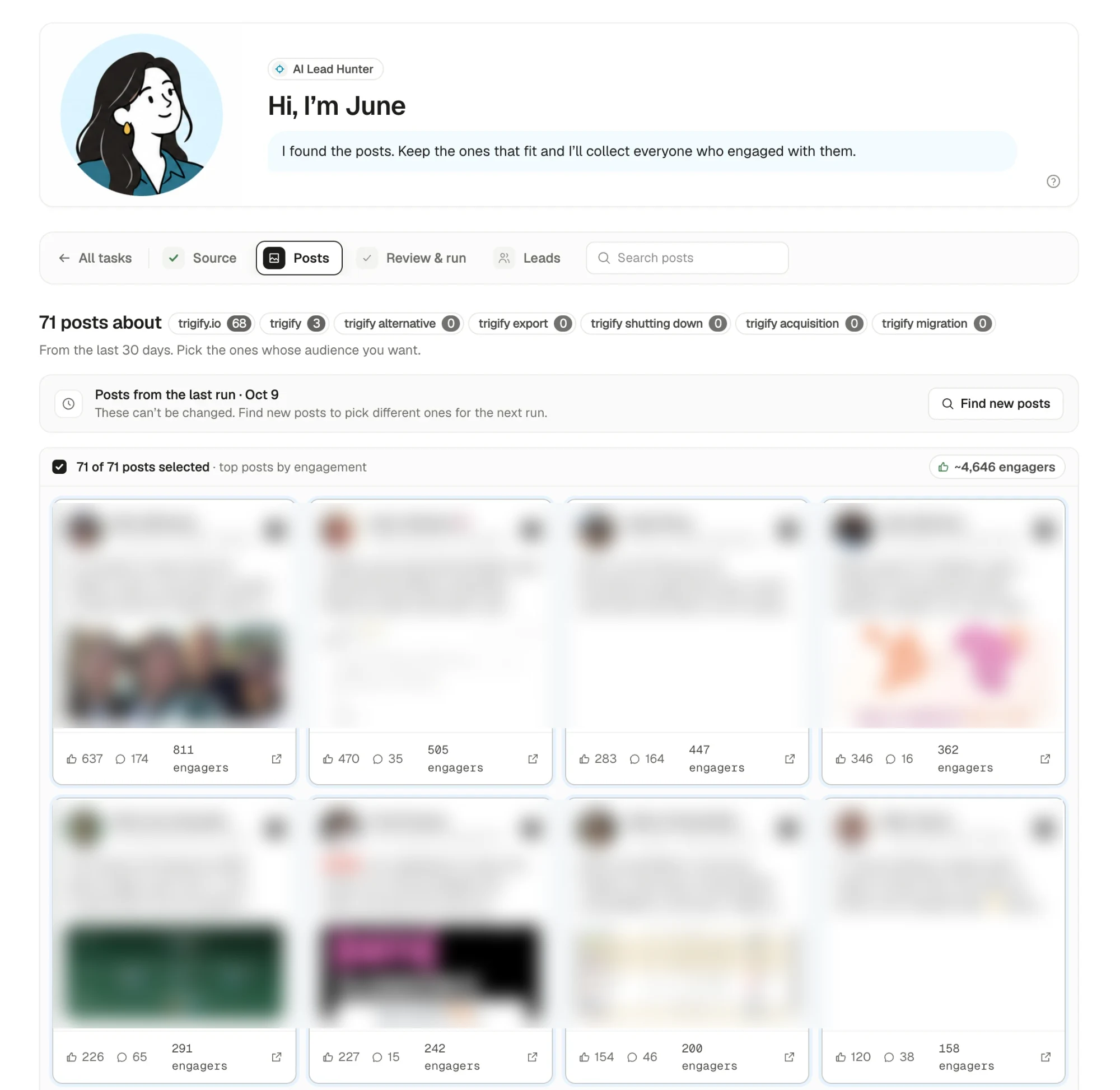
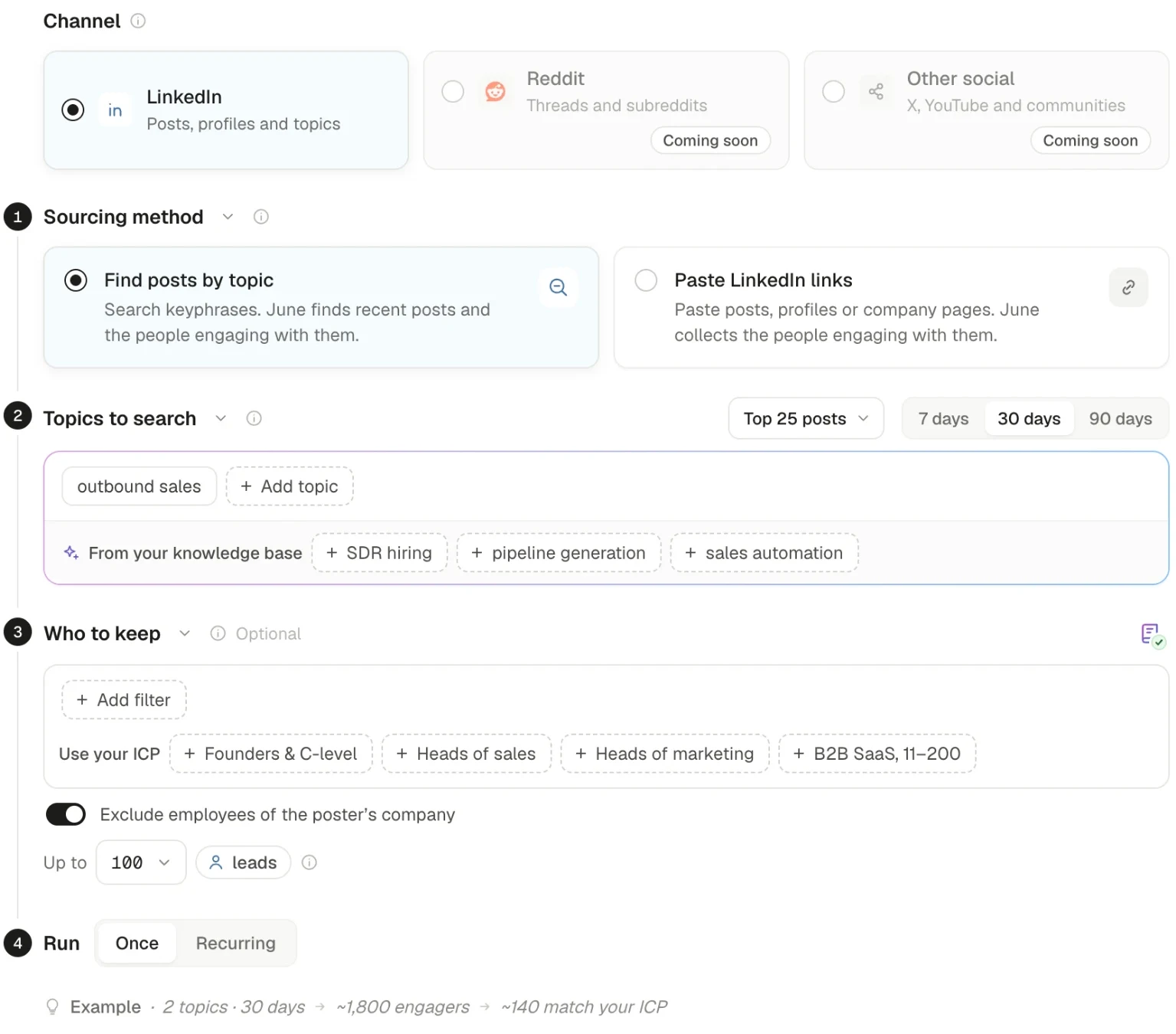
- Spot the signal. We gave Seleqt's AI lead hunter two tasks. The first watched Trigify's own company page: people who engage with a tool's posts are often its users. The second searched LinkedIn posts from the last 30 days for seven topics: "trigify.io," "trigify," "trigify alternative," "trigify export," "trigify shutting down," "trigify acquisition" and "trigify migration." Together, they turned up 96 posts and about 6,400 engagers.
- Qualify. Not everyone who likes a post is a buyer. AI qualification checked each person against our ICP: agencies and B2B teams where the person works in sales, growth or leadership and runs outbound. It filtered out Trigify and HubSpot employees, other tool vendors, and people outside our market. Every match came with its reason and source, so we reviewed the list before anything was sent.
- Find contact details. Waterfall enrichment found verified work emails for the qualified leads, so the campaign could run on both channels.
- Lead with help, not a pitch. The first message opened with the deadline and a checklist of what to export before access ended, from our free migration guide. The offer came second: free setup of their trackers in Seleqt, and the first month free.
- Follow up across channels. One multichannel sequence: a LinkedIn connection request, a LinkedIn message once connected, then an email with the checklist, and a reminder before the October 22 deadline. Anyone who replied on one channel stopped receiving messages on the other.
- Track the outcome. Replies from both channels landed in one inbox, and booked meetings were tracked against the campaign.
The first message, in short:
Hi {first name}, with Trigify shutting down on October 22, here's a checklist of what to export before your access ends. If you're looking for a replacement, we'll set up your trackers in Seleqt for free, and your first month is on us. Seleqt also qualifies the people it finds and runs the LinkedIn and email outreach, so you can replace more than one tool.
Notice what it doesn't say: nothing about which post they liked. It references the change everyone already knew about, not the click.
More than a signal swap
Trigify found signals. Most of its users still needed other tools to act on them: a spreadsheet or Clay to qualify, a data provider for emails, and a sequencer or LinkedIn tool to send. So our pitch wasn't "replace your signal tool." It was "replace the signal tool and the steps after it": the trackers they already had, plus qualification, contact details, LinkedIn and email outreach, and one inbox, in one workspace.
That's the bigger lesson for any signal-based campaign. The signal gets you the right person at the right time. What you do in the next 48 hours decides whether it becomes a meeting.
The results so far
| Campaign so far | Number |
|---|---|
| Company page task | 25 posts, about 1,815 people engaging |
| Topic task (7 topics, last 30 days) | 71 posts, about 4,646 people engaging |
| Total across both tasks | 96 posts, about 6,400 engagers |
| Qualified leads in the first week | 15 |
| Channels | LinkedIn and email |
| Offer | Migration checklist, free tracker setup, first month free |
15 qualified leads in one week, each with a fit, a deadline and a reason to talk. Compare that with a cold list: thousands of contacts, no reason to reach out, and no idea who's actually looking.
Numbers as of October 17, 2026. The campaign runs until November 7, and we'll update this post with reply and meeting numbers after that.
What we learned
- Search the name, not the phrase. Almost every post came from the topics "trigify.io" (68) and "trigify" (3). Phrases like "trigify alternative" and "trigify migration" found nothing. People talk about the brand, not about the problem in your words.
- The conversation happens on people's profiles. The company page's own HubSpot announcement drew 47 engagers. The same news, posted by the founder, drew 811. Track the people behind a company, not just its page.
- Most engagers aren't buyers. News like this draws peers, partners, vendors and followers. Qualification is what turned thousands of engagers into 15 qualified leads in the first week.
- Lead with a reason that isn't about you. The deadline gave every message a purpose the reader already cared about, and we led with help (an export checklist and free setup), not a demo request.
- Keep it in one workflow. The signal, qualification, contact details and outreach ran in one place, so no lead sat in a spreadsheet while the deadline got closer.
If you're still on Trigify, the Switch Pass is open until November 7.
The workflow in Seleqt
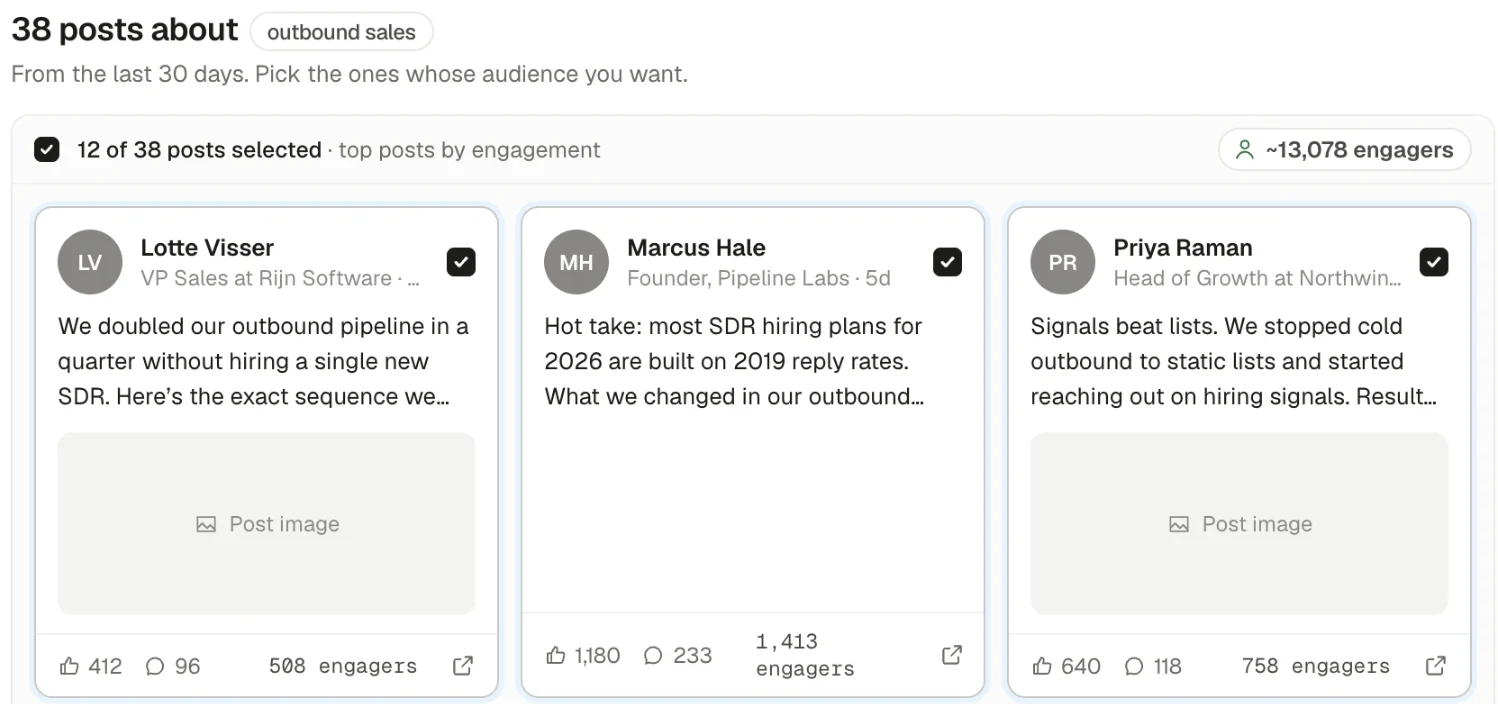
- Seleqt's AI lead hunter finds people engaging on LinkedIn with your posts, your company page, competitors' posts and topics you choose, and refreshes every few hours.
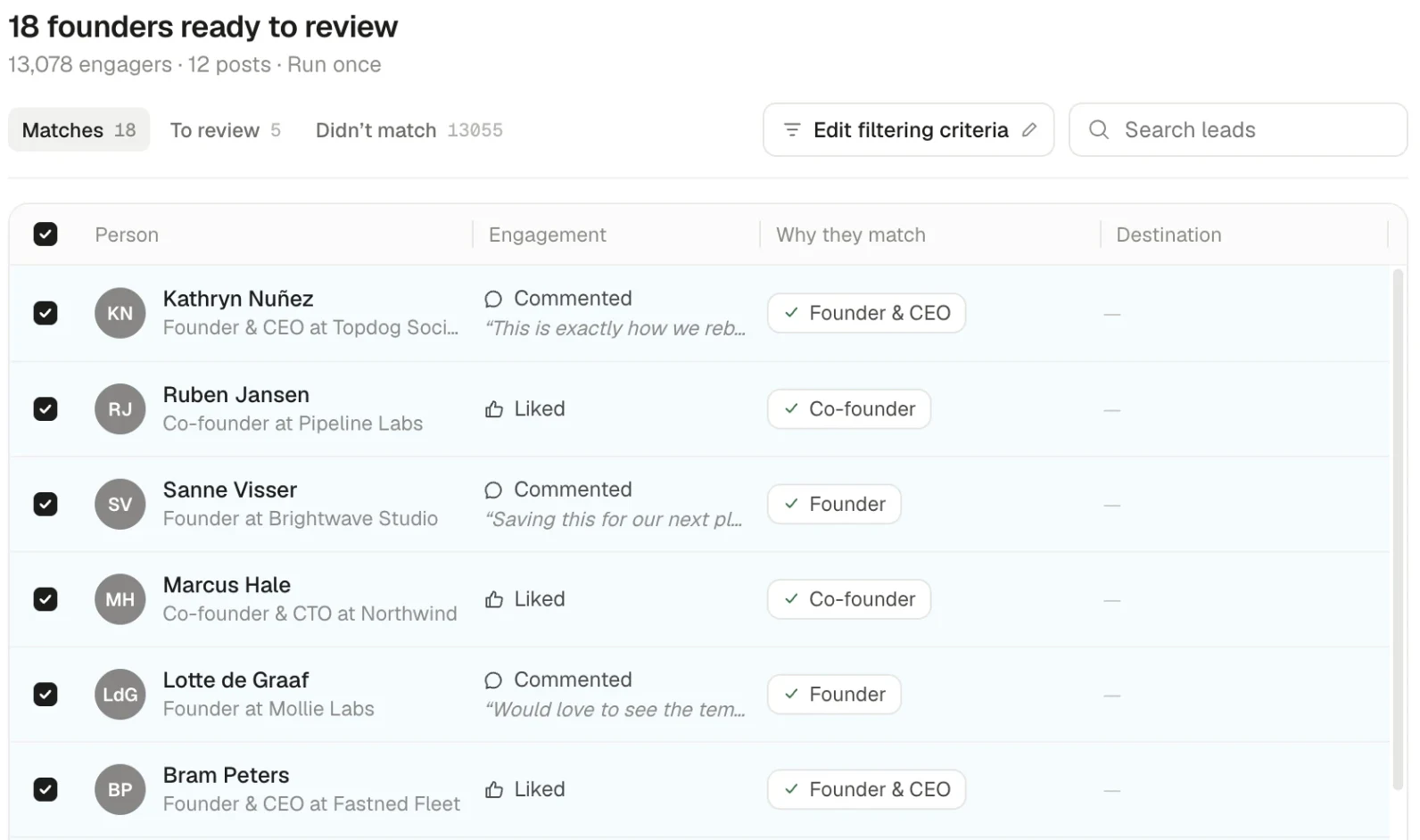
- AI qualification researches each company's website and buying signals, such as hiring, funding and news, and scores each lead against your ICP with the reasons and sources behind it.
- Contact details come from a waterfall across 20+ providers, and you only pay for what's found.
- Multichannel campaigns run LinkedIn, email and WhatsApp in one sequence, with AI personalization that references the signal.
- One inbox holds every reply, booked meetings are tracked per campaign, and CRM sync sends positive replies to HubSpot, Pipedrive, Attio and more.
Here's what the first two steps look like:
What Seleqt covers today
We'd rather be clear about this than oversell it. Here's how the signals from the report map to Seleqt:
| Signal | In Seleqt today |
|---|---|
| Content engagement | Yes People who like or comment on your LinkedIn posts and company page |
| Website visits | No Lives in your website tools; import those lists to qualify and contact them |
| Product usage | No Lives in your product data; import those lists the same way |
| Social activity | LinkedIn Engagement with competitors' posts and topics. Reddit, X and YouTube are coming soon |
| Champion movements | Partly Job changes such as a new sales leader at a target account |
| Hiring activity | Yes Open roles from LinkedIn Jobs and careers pages |
| Leadership changes | Yes New leaders from profile updates |
| Company events | Yes Funding, expansion and other company news, found by AI research |
| Tech changes | Partly Custom AI checks on a company's website and job posts |
For agencies
Run signal campaigns per client in separate workspaces, under your own brand. Use campaign previews to show a prospect who's showing signals in their market before they sign. More on Seleqt for agencies.
How do you start? A 5-step, 30-day plan
- Pick two signals (week 1). One first-party signal you already have, like content engagement, and one third-party signal that fits your offer, like hiring for a role you support. In Seleqt: set up an AI lead hunter task for each.
- Write your ICP in plain language (week 1). "B2B SaaS, 20–200 people, hiring SDRs" works better than a list of filters. In Seleqt: turn it into an AI qualification column.
- Write three messages per signal (week 1). Each one opens with the reason you're reaching out. Test them on real leads before launch.
- Run a pilot (weeks 2–3). Start with about 100 qualified leads across LinkedIn and email. Review the first replies and adjust.
- Measure meetings per signal (week 4). Keep the signal that books meetings, drop the one that doesn't, and add the next one. In Seleqt: booked meetings are tracked per campaign.
Frequently asked questions
Is cold outreach dead?
No, but it's over-saturated. The 2026 State of B2B GTM Report puts cold outreach in the "popular, but lower impact" group. It's still widely used, especially for $5–50k deals, but generic messages earn less every year. Outreach tied to a clear reason performs better.
What's the difference between signal-based outbound and intent data?
Intent data is one kind of signal, usually third-party research activity measured at the account level. Signal-based outbound is the practice of acting on any signal, such as engagement, hiring, leadership changes, company news or intent data, by qualifying the lead and reaching out while the signal is fresh.
How fast should you reach out after a signal?
Within days, not weeks. Engagement and company news fade quickly. Hiring and leadership changes stay relevant longer, but the first suppliers to reach out with something useful have the advantage.
How much does signal-based outbound cost?
It depends on your stack. Combining a signal tool, a data provider, a sequencer and a LinkedIn tool means paying for each. Seleqt runs signals, qualification, contact details and multichannel outreach in one workspace, from $79 per month ($59 billed yearly), with a 14-day free trial. See pricing for what each plan includes.
Can a small team run signal-based outbound?
Yes. Start with two signals and a pilot of about 100 qualified leads. Signal-based outbound needs less volume than cold outreach, so a small team or a founder can run it, as long as the signal, qualification and outreach are connected.
Is signal-based outbound GDPR compliant?
It can be. In the EU, B2B outreach usually relies on legitimate interest: contact people about something relevant to their role, use business data, explain where you found them if asked, and make opting out easy. Rules vary by country and channel, so check with your own legal advisor. Seleqt provides a data processing addendum.
Find your first signal-based leads
Cold outreach isn't going away, but the teams that grow next year will be the ones that reach out for a reason. Start with two signals, one campaign and 30 days.
Spot buying signals. Book more meetings.
Start your 14-day free trial → · See Seleqt's AI lead hunter
Report data and product information were reviewed for this post on October 17, 2026.
Sources
Reports and press releases, read October 17, 2026: 2026 State of B2B GTM Report, Growth Unhinged · 2026 State of B2B GTM Report, GTM Strategist · State of B2B GTM report site · Gartner: 61% of B2B buyers prefer a rep-free buying experience (June 2025) · Gartner: the B2B buying journey · Gartner 2026 CMO Spend Survey (May 2026)
Seleqt: AI lead hunter · AI qualification · Pricing · Trigify shutdown migration guide